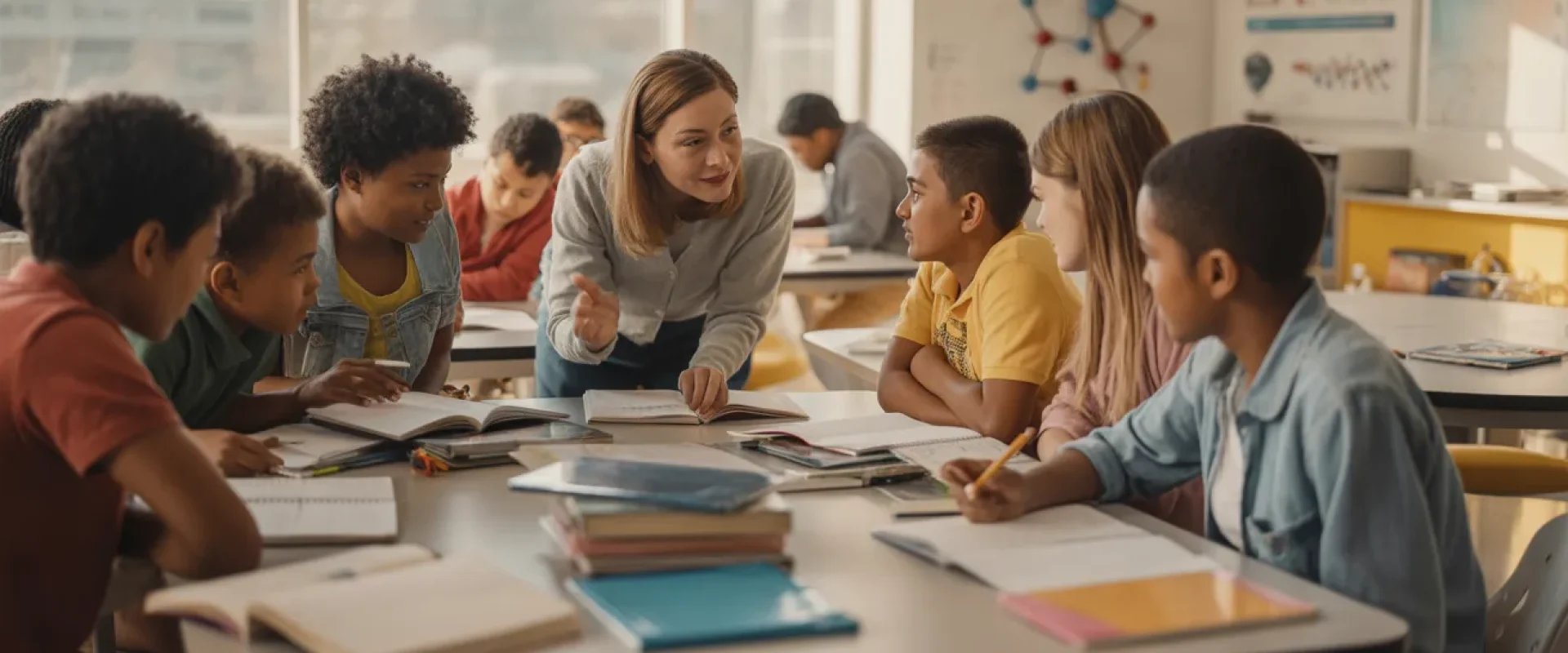
Understanding the Changing World of Education
1. Why Future Skills Matter Today
Admit it, nowadays education is not what it was. Days lost are when all that was needed to pass was learning and memorizing texts and attaining marks. Our world is faster than ever and is affected by artificial intelligence, automation, climate change, and global competition. Schools are turning out not only into educational institutions, but training schools of life. This transformation has been the reason behind the way schools equip students with the future through emphasis on skillsets other than mere knowledge.
The OECD Skills Outlook 2025 indicates that today, not only literacy and numeracy are required in modern economies, but also adaptive problem-solving/social-emotional skills are also necessary to enable individuals to succeed in unpredictable environments. This implies that the students should be prepared to think, work in a team, and be fast learners. And it is not a fiction that the future careers are like a game where the rules continuously change. It is high time schools are matching their teaching methods with this fact.
The question is therefore not whether the students are learning or not, but whether they are learning the right things. Skills that are commonly regarded as important in the future such as creativity, critical thinking, and emotional intelligence are taking precedence over traditional academics. And schools are changing fast in order to satisfy them.
2. Global Trends Shaping Education
Once you zoom in to the global picture, you will see that there is a giant change in the process of education that is occurring across the world. Technology is transforming classrooms, industries are re-controlling job descriptions and societies are being more demanding of multi-purpose individuals. These trends have a direct effect on education in terms of its contribution to meeting future struggles.
As an example, it is said that the use of AI can eliminate 85 million jobs and generate 97 million new jobs in the world, which is why it is necessary to provide education based on skills as quickly as possible. This does not mean that jobs are being abolished but this is simply an indication that the jobs are evolving. Schools are responding by introducing coding, robotics and digital literacy into school.
The other important trend is the movement towards life long learning. Education is not an annual event, it is a life long process. Schools are now more focused on learning to learn, and not on what to learn. This attitude makes students ready to continue to update their skills in their life.
Importance of 21st Century Skills in Education
1. Core Skills Every Student Needs
When discussing the significance of 21st century skills in education, we mean a set of skills which is beyond the textbooks. They are critical thinking, creativity, communication and collaboration and digital literacy. Take them as the survival kit of the contemporary world.
These competencies are necessary since they assist a student in negotiating complicated issues and ambiguous circumstances. As an illustration, students do not learn math equations but rather learn how to use arithmetic ideas in real-world situations such as in budgeting or analysis of data. This practical way of learning renders learning more significant and pertinent.
Some of the skills of the 21st century could be summarized as follows:
| Skill | Why It Matters |
| Critical Thinking | Assist students to solve problems |
| Communication | Allows expression of ideas well |
| Collaboration | Promotes collaboration and teamwork |
| Creativity | Promotes innovativeness and new ideas |
| Digital Literacy | Prepares the students to work in technologically intensive environments |
2. Cognitive: Social: Emotional
The modern approach to education is that of intellectual, emotional and social growth. Schools are becoming more and more integrated with programs that improve empathy, resilience, and self-awareness. Why? Since, academic knowledge is only as important as emotional intelligence in determining success in life.
Such social and emotional skills as adaptive, open and emotional stability have been identified to be determinants of success in the modern workplaces. This means that schools are now training the students on how to deal with stress, teams and effective communications.
Take a case of a student who is academically bright yet has no ability to collaborate with others or to handle pressure. Such a student might not cope in real-life circumstances. That is why schools are doing the holistic approach; they are developing the mind and the personality.
How Schools Develop Critical Thinking Skills
1. Problem-Based Learning Methods
Problem-based learning (PBL) is one of the most effective methods of school development of critical thinking. Teachers do not introduce the students to pre-prepared answers, instead, to the problems of the real world, and they motivate the students to discover answers themselves.
As an example, students can be targeted to create a sustainable city, or resolve the environmental problem in their neighborhood. This strategy challenges them to process information, evaluate alternatives, and make decisions, which are important in the future.
Research reveals that interactive learning techniques are very effective in enhancing students’ critical thinking skills particularly when they are incorporated with practical learning activities and applications. In a bid to equip students with learning skills to deal with complicated issues, schools are abandoning rote learning and implementing experiential learning.
2. Inquiry and Research-Based Activities
Inquiry-based learning is also another effective approach. In this case, students are advised to pose questions, perform research, and study issues in-depth. This does not only increase their knowledge level but curiosity, which is one of the main sources of innovation.
As an example, students may not passively learn about climate change but rather perform experiments and data analysis and make suggestions. This will make them stop being mere learners and become active thinkers.
The Use of Technology in the Contemporary Education
1. Digital Literacy: Basic Skill
The role in contemporary education is too important. Digital literacy is an essential part of the modern world as reading and writing. Learners must learn how to make effective use of technology not only to have entertainment, but also to learn, to communicate and to solve problems.
Analysts believe that digital literacy has become a new fundamental skill required to survive in the new world. Online learning platforms, digital assignments, and even virtual simulations are some of the means of using technology in the classroom that are becoming integrated in schools.
2. Use of AI and Smart Classrooms
Technology is changing the manner in which students learn, and that is through smart boards up to AI-powered learning devices. Individual learning systems have the ability to move at the students pace and thus they learn and remember.
Using the above as an example, AI is able to detect weaknesses in a student and give him/her specific exercises to enhance performance. This renders learning more effective and student focused.
How Schools Build Leadership Skills in Students
1. Student Councils and Activities
Being a leader does not come in a textbook, it comes to pass. Leadership is developed in schools through the engagement of the students in such activities as student councils, debates, and group projects.
These platforms enable the students to be responsible and make decisions and lead teams. Over the long term, they acquire the feeling of confidence and responsibility- virtues of success in the future.
2. Collaborative Learning Environments
Another very important method of building leadership is through team work and working as a group. Through working with other students, the students learn how to address conflicts, share ideas, and assist each other.
Such a participative style is a mirror of the real world working environment where teamwork is needed.
The use of Education to deal with future challenges
1. Flexibility and Sturdiness
There is uncertainty in life and uncertainty in future. The schools are training the students on how to learn to accept the change and bounce back in the event of failure. Through working with other students, the students learn how to address conflicts, share ideas, and assist each other. It is this strength that will enable people to succeed in difficult circumstances.
2. Career Readiness and Employability
Contemporary education is geared towards career preparation and not merely exam preparation. To improve employability, schools are implementing vocational training, internship programs and skill-based programs.
The rate of employability in India has increased to 56.35 in the year 2026 which is a good sign that India is moving towards a skilled workforce.
Practical Examples of Future-Ready Education
1. STEM and Innovation Labs
The STEM laboratories are emerging in most schools where students are able to conduct tests on science, technology, engineering and mathematics. The laboratories promote innovation and creativity.
2. Real-World Projects and Internships
Students are also getting exposed to more and more projects which involve them being engaged in real world situations. This practical experience would assist them in realizing real life applications of their learning.
Painful Realities Schools are Experiencing in Student Preparation
With or without such a development, schools face a variety of issues including inadequate resources, outdated curriculum and access to good education. These issues are vital to address them to make sure that every student is satisfied with the future.
The Future of Education Systems
Personalization, integration of technology and learning based on skills is the future of education. The schooling will also be changing, placing more emphasis on personal strengths and practical usage.
Conclusion
Education does not relate to memorization of facts anymore, it is about getting ready to live. Schools are developing to be dynamic and learning centers where students are taught to think and make changes and be leaders. When speaking about the ways students are taught about the future, one can easily notice the move towards skill based learning, use of technology, and holistic development. Such growth ensures that students are not ready to take examinations, but are ready to face difficulties in life.
FAQs
1. Why are 21st century skills relevant in education?
They help the students to be critical thinkers, creative and flexible, which is the peak of success in the modern career.
2. How do schools develop critical thinking skills?
Through problem-based learning, real-life inquiries and projects.
3. What is the place of technology in contemporary education?
Digital technologies, customized learning, and access to information around the globe are some of the ways that technology enhances learning.
4. How do schools build leadership skills in students?
Through promotion of student councils, teamwork and extra curricular activities.
5. What role does education play in enabling students to deal with the challenges in the future?
It equally helps them to be tough and adaptable and to resolve issues they are quite likely to be in any uncertain circumstances.